AI tools for business help modern businesses?
With time, businesses have been striving for innovation, agility, and efficiency, but automation continues to remain at the forefront of digital transformation. Today, AI tools for business are transforming how organizations operate. Though traditional automation has remarkably improved productivity by mechanizing repetitive jobs, it has a rigid nature, and that limits its intelligence and adaptability. Contrarily, AI agents have introduced a new period of automation that is capable of self-improvement besides being intelligent and dynamic.
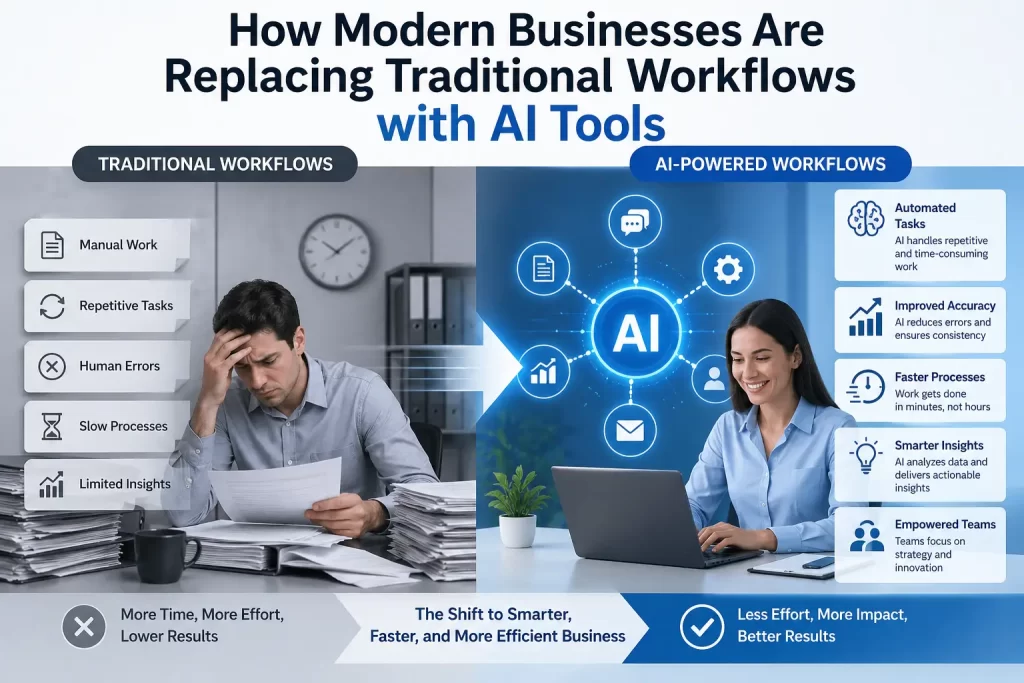
Some reasons why businesses try to use AI tools for business are:
Adaptability and intelligence
If you observe a little, you will find traditional automation to be rule-based, and it suggests it follows a predefined workflow that ought to be programmed explicitly. This factor makes it unsuitable for a dynamic surrounding where conditions change frequently. AI automation for businesses tools is powered by NLP and machine learning. Hence, it can adapt to novice scenarios without any kind of manual interference. It learns from interactions, contextual cues, and historical data. This factor enables it to refine its responses. This adaptability is hugely useful in industries, including customer service, as here, queries vary a lot.
Dealing With Unstructured Data
Traditional automation is also limited because it is dependent on structured data, like databases and spreadsheets. Nonetheless, in this digital age, most business data tend to be unstructured, and they comprise images, emails, scanned documents, voice recordings, and videos. AI tools for business can process unstructured data utilizing progressive techniques such as NLP, speech recognition, and computer vision. For instance, AI analyzes medical images. It also interprets physician notes and extracts insights from the histories of patients in healthcare.
Decision-making capacities
Traditional automation tools are capable of executing tasks according to predefined rules, and they need explicit programming for all scenarios. When an exception arises, then human intervention becomes necessary as it enhances both operational costs and response time. This kind of rigidity confines their capability to deal with variable and complex scenarios. On the contrary, AI automation for businesses tools uses deep learning models, contextual reasoning, and predictive analytics for making real-time decisions. For instance, in the sphere of cybersecurity, AI-driven agents analyze network activity. They also detect anomalies and decide whether it would be ideal to block suspicious behavior or not.
Cost efficiency and scalability of AI tools for business
Most often, to scale traditional automation solutions, manual reconfiguration and remarkable infrastructure investments are needed. For example, to add new RPA (Robotic Process Automation) bots for accommodating growing workloads, additional licenses and ongoing maintenance are needed. Nonetheless, AI tools for business are inherently scalable. A cloud-based AI model can process augmenting volumes of data without the requirement for high infrastructure changes. Again, AI-powered automation also lowers operational costs by lessening human involvement and optimizing workflows.
Incessant improvement and learning
A huge disadvantage of traditional automation is it is of a static nature. When it is deployed, it continues to remain unchanged unless it is updated manually. It turns out to be both time-consuming and costly to keep up with the continuous business requirements as well as regulatory changes. In contrast, AI automation for businesses tools learns from new interactions, data, and outcomes continuously. With the help of reinforcement learning, AI-driven systems have become more efficient and accurate. For instance, virtual assistants enhance their responses according to user queries, and fraud detection models do refine their preciseness by assessing past incidents.
Speed of operations
Speed of operations is another remarkable benefit of AI tools for business. AI tools can finish any task in only some moments, but traditional systems take them to complete in hours, and at times, days. This allows quicker decision-making as well as response times.
Quicker time-to-market
AI automation for businesses tools automates repetitive jobs in software development, like code testing and code deployment. Thus, developers can concentrate on highly creative and complex aspects of a project. Besides, AI tools also help in assessing market trends and assessing customer data. This ultimately assists businesses in developing products that can cater to the customer needs and lower the risks of product failures and expensive redesigns.
Conclusion
According to statistics, today, the entire market is AI-powered. Hence, whoever fails to adapt to AI tools for business falls behind. Most often, people confront the challenge of adopting these tools, but once they get a good understanding of them, they feel them to be worthy of their expectations. The best tools understand the concerns about potential ROI related to money and time. This is why they can stand out all the time. When you are all ready to change your process, it is mandatory for you to embrace AI tools.