Traditional SEO: An overview – Want to know AI SEO vs SEO? For this, you must have a good understanding of both. Traditional SEO or search engine optimization is the procedure of enhancing the visibility of your website on search engines, including Bing and Google. This is not what marketers have been involved with for years.
The goal of traditional SEO is very simple. If a person types his query on Google, he wants his content to appear at the top.
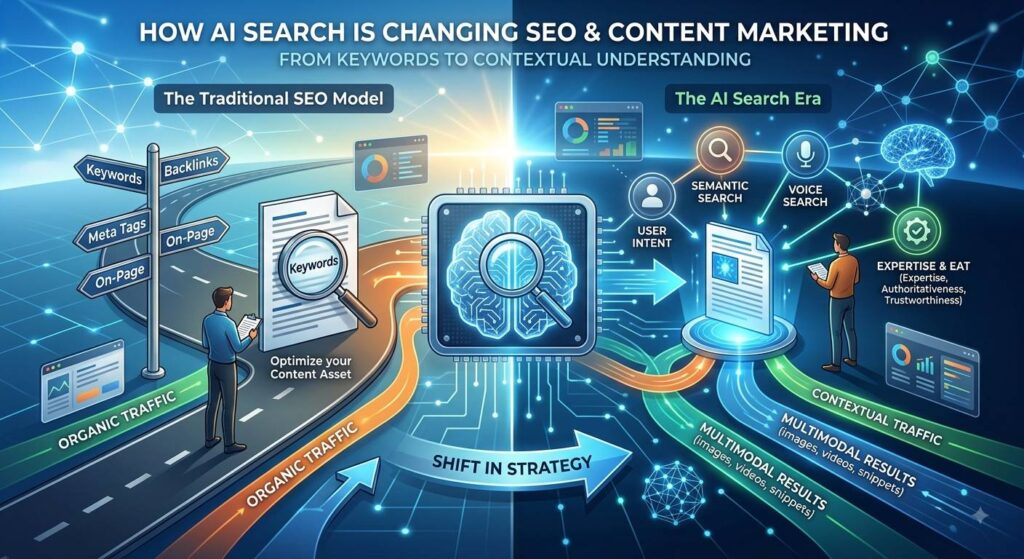
A general guide of AI SEO
Traditional SEO services make content easy for humans and Google to find as well as understand. Contrarily, AI finds AI SEO easy to find, understand, and rely upon. Hence, it ensures that content should be
Structured and clear – You must use headings, schema markup, and bullet points to help AI parse the content efficiently.
Factually correct – AI tools work to reward reliable information, as inconsistencies or misinformation can damage your opportunities of being cited.
Consistent – You must maintain quality and accuracy all through your site, as AI systems support sources that display trustworthiness with time.
Topically authoritative – Always cover your subject thoroughly, as it will show your depth and expertise. Again, this way, AI too will recognize your content easily and treat it as a trustworthy source.
Focus of Traditional SEO
To have a good understanding of traditional SEO vs AI SEO, you should know that traditional SEO concentrates on ranking a web page in search engine lists so that it can drive traffic and direct clicks. Again, AI SEO, optimizes content so that some AI platforms, like Google AI Overviews, Perplexity, and ChatGPT, can understand, cite, and summarize a brand directly.
Factors that make AI SEO and traditional SEO different
Another important point in AI SEO vs SEO is traditional SEO works to improve a website so that it becomes visible in SERPs, or search engine results pages. On the other hand, AI SEO concentrates on enhancing content so that it appears in AI-generated answers from tools, including Google’s AI Overviews, Gemini, and ChatGPT.
Some industry research suggests that traffic and discovery through AI platforms could become increasingly important compared with traditional organic search. It suggests people need to optimize for AI platforms besides traditional search engines so that they can maintain the visibility of a brand in the long term.
What changes when people incorporate AI SEO into their SEO work?
When you begin to incorporate AI SEO services into your SEO jobs, then it commonly involves a shift in priorities. Some vital SEO jobs and what their AI SEO equivalents do look like are the following:
Topic planning and keyword research
In traditional SEO vs AI SEO, AI SEO includes mapping the whole topic area instead of optimizing for one or multiple particular terms. Because of the conversational nature of some AI tools, like Claude and ChatGPT, users may prompt them with what looks like a limitless number of variations on a typical keyword. Again, the AI tools themselves utilize query fan-out for performing several related searches at once.
In comparison to keyword targeting, prompt targeting commonly involves a long string of words. Using AI SEO, you habitually target more specific terms compared to what you would when you use traditional SEO. Hence, it is important to have a good understanding of your target audience besides the intent that works behind their prompt or keyword.
Why is on-page optimization important?
On-page optimization for AI SEO services focuses on how a person writes his content-using standalone sections and direct language that makes it easier for an AI system to use and extract in responses.
When you use traditional SEO, then on-page optimization involves jobs like internal linking, optimizing images, and placement of keywords. AI systems extract a huge chunk of content before combining it with information that comes from other sources. Therefore, all sectors need to make sense even when they don’t use context from other parts of a page.
Technical optimization
In AI SEO vs SEO, people use technical SEO for AI as it ensures that major AI crawlers render JavaScript. It means JavaScript-heavy sites might have issues with their visibility.
Commonly, traditional technical SEO involves the following:
Setting up a robots.txt file
Ensuring that your site is both indexable and crawlable
Fixing loops and redirect chains
Enhancing your Core Web Vitals metrics
Using HTTPS for security
Implementing search engine-friendly and user-friendly site structure
Using schema markup
Before AI tools crawl content, they ought to access it. It suggests you must not block AI crawlers in your robots.txt file.
Developing links
AI tools give worth to mentions of a brand across the web. Though brand mentions may also assist with traditional SEO. To find out AI SEO vs SEO, a search engine tends to reward those websites that have several high-quality links that point to them.
Getting featured in expert roundups, news articles, industry publications, and review websites now gets people the backlink as well as the brand mentioned. Even publications use a no-follow link that makes a link less valuable for SEO. Still, AI tools consider the mention when it answers user queries.
The ideal method of tracking AI SEO performance and SEO
When you set out to measure success across traditional SEO vs AI SEO, you have to track both traditional ranking metrics as well as new AI visibility signals so that you understand your general online presence.
Always track traditional metrics, as they matter a lot.
Keep on tracking traditional SEO metrics like the following:
Keyword rankings – They uncover position changes for a target term.
Organic traffic by page – It is used to see which content is successful in driving visits.
CTR – CTR or click-through rate measures how compelling a title is. It also measures the descriptions that people see in search results.
Conversion rate – Conversion rate is used to track whether traffic is running into sales or leads.
The utilization of Google Analytics
Google Analytics helps in tracking conversions and organic traffic. Thus, it can find out the factors of AI SEO vs SEO. However, Google Search Console is used for tracking rankings and CTR for nearly 1000 terms. To keep a tab on the specific terms that people mostly care about, they use position tracking from Semrush. This tool shows the general visibility of some tracked keywords. They also give people a keyword-level breakdown, like traffic changes and position over time.
Conclusion
Though debates continue to fly regarding AI SEO vs SEO, traditional SEO remains vital to build search rankings, organic traffic, and domain authority. AI SEO services complement the structure by ensuring that content is understandable, discoverable, and cited by an AI-powered search tool. When it is optimized for both AI and humans, you will be able to create content that will rank on Google and also appear in AI-generated answers, knowledge panels, and summaries. To become successful, concentrate on clear headings, structured data, factual accuracy, and optical authority, as these components help content to stand out to both AI systems and search engines.